Play details
| Playwright | Louise Bryant |
| First published | 1916 |
| Period | Early 20th century |
| Location | Symbolic realm |
| Format | One-act play |
| Cast size | 4 (2 M / 2 F) |
| Genre(s) | Morality Play |
Introduction to The Game
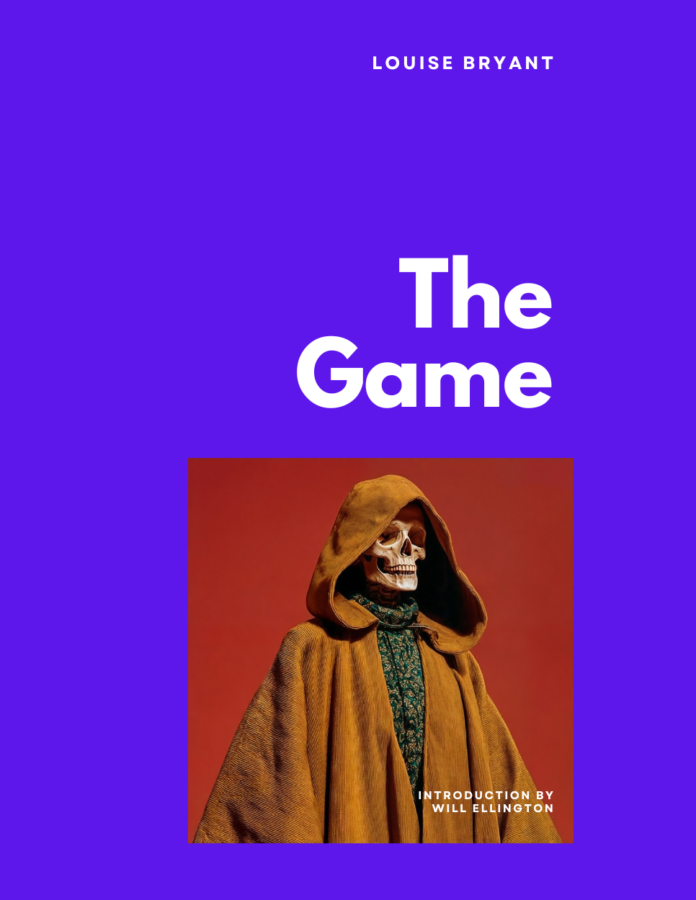
Louise Bryant’s The Game is a compact, four-character allegory that turns the oldest human argument, whether life is worth the pain, into a literal contest between Life and Death, decided by dice. Written in the mid-1910s (the published text carries a 1915 copyright notice) and shaped for production during the 1916 Provincetown season, the play sits squarely inside the birth of American experimental “little theatre,” when writers and artists were trying to reinvent drama outside Broadway conventions.
Bryant moved in the radical-bohemian circles of Greenwich Village and Provincetown, overlapping communities of journalists, painters, activists, and playwrights who treated art as a communal project and the stage as a proving ground for new forms. In spring 1916, theater organizer George Cram Cook encouraged Bryant to contribute a play for the Provincetown summer productions, the same creative push he was giving to her partner John Reed. The resulting work is less a realistic story than a stylized argument: two young artists—The Youth (a poet) and The Girl (a dancer)—arrive intending suicide after concluding that “love” has failed them. Life tries to save them by reframing their despair: what they called love, she suggests, was really desire, and real love is bound up with understanding, creation, and the ability to recognize one another’s inner life.
The play is also unmistakably a product of its moment. Bryant jolts her timeless allegory with pointed contemporary references to World War I, Life flippantly offering Death a trade of monarchs and soldiers, only to reveal, in the play’s final beat, the private grief behind that posture. The tension between public indifference and personal anguish becomes part of the play’s moral psychology: Life appears dazzling and manipulative, Death calm and sardonic, and both claim to be governed by “the law” of the game, chance, fate, and the cold arithmetic of loss.
Historically, The Game is remembered as much for its staging as for its dialogue. When the Provincetown Players opened their first New York bill at 139 MacDougal Street on November 3, 1916, The Game appeared alongside Floyd Dell’s King Arthur’s Socks and Eugene O’Neill’s Bound East for Cardiff. Bryant’s play became a showcase for visual modernism through the work of artists William and Marguerite Zorach, who designed and directed it with an intentionally non-realistic approach, abstract, suggestive décor; formalized, “flat-plane” movement; and a stylized seascape-and-moon backdrop that emphasized mood over literal place.
Read today, The Game plays like a philosophical duel in theatrical miniature. It does not deny Death’s inevitability; instead it argues that even brief moments of love, art, and mutual recognition can outweigh the temptation of oblivion, and that “dreamers,” not kings or armies, are the figures Life most urgently fights to keep.