Play details
| Playwright | William Butler Yeats |
| First published | 1921 |
| Period | Early 20th century |
| Location | Any bare space |
| Format | Free form |
| Cast size | 6 (2 M / 1 F / 3 Musicians) |
| Genre(s) | Avant garde, Dance drama, Theatre ritual |
Introduction to At the Hawk’s Well
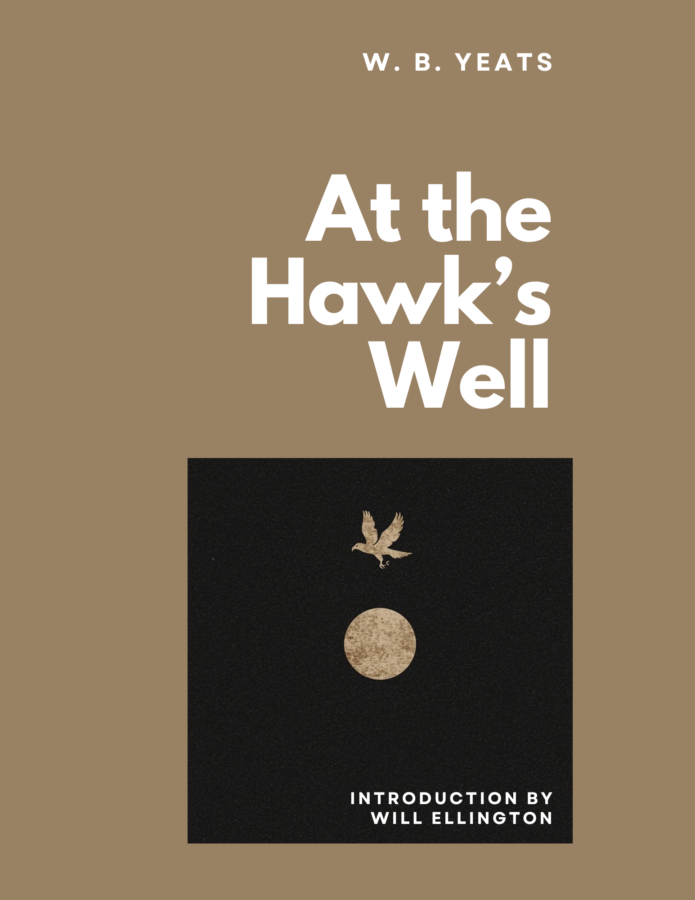
W. B. Yeats’s At the Hawk’s Well (1916) is one of the most intriguing and influential experiments in early twentieth-century theatre. An Irish heroic legend staged as a spare, musical, mask-like ritual that rejects naturalistic acting and the idea of the “well-made play.” Yeats wrote it while pursuing what he imagined as a more elevated, ceremonial form of poetic drama, and later published it with three more works in a compilation titled Four Plays for Dancers (1921), all written between 1915–1920 (Britannica, 2026).
The play’s story comes from Yeats’s lifelong engagement with the Ulster Cycle of Irish heroic legends, and specifically with the hero Cú Chulainn. Cú Chulainn (pronounced koo-KHUL-in) was a warrior of extraordinary strength and skill, able to perform superhuman feats in battle. He is often described as both brilliant and terrifying, especially when he enters his battle frenzy, or ríastrad, which transforms him into an almost monstrous figure. Though famed for his courage and loyalty, Cú Chulainn’s life is marked by tragic inevitability bound by fate, geasa (sacred taboos), and heroic pride, he attains glory at the cost of his own life. For Yeats, Cú Chulainn embodied the tension between youthful heroism and doomed destiny, making him a powerful symbol for mythic drama and national imagination.
In the play, a miraculous well, which rises only at rare moments, offers a chance at immortality, but the rub is that human desire and attention fail precisely when fulfillment is near. An Old Man has waited by the well for fifty years, clinging to the promise of transcendence. The young hero Cuchulain arrives intent on seizing destiny. Yet both are defeated in the same way: at the instant the water is about to rise, the Guardian of the Well, an uncanny hawk-like figure, awakens and performs a dance that draws the men away, so the moment passes unused.
What made the play seem so unfamiliar to audiences in 1916 was its theatrical form. Yeats shaped the work under the influence of Japanese Noh theatre as it entered Anglophone modernist circles through translation, lectures, and artistic discussion. Yeats learned about Noh largely indirectly through American poet Ezra Pound, who was editing materials by Japanese art historian, Ernest Fenollosa. Yeats adapted aspects of the noh use of masks, minimal scenic suggestion, choral music, concentrated poetic imagery, and a climactic dance that carries meaning through movement rather than psychology (Jochum, 2013: 96).
The play is widely associated with Yeats’s collaboration period with Pound at Stone Cottage, which was Yeats’s first burst of enthusiasm for Japanese theatre. The first performance likewise highlights how avant-garde and “private” this theatrical experiment initially was: At the Hawk’s Well premiered on 2 April 1916 in Lady Emerald Cunard’s drawing room in Cavendish Square, London, before an invited audience, with pioneering Japanese dancer and choreographer, Michio Ito, dancing the non-speaking role of the Guardian of the Well (Donoghue, 2013).
Thematically, At the Hawk’s Well turns on the tension between transcendence and embodiment. The well promises an escape from time, but the body with its impulses, desires, and distractions asserts itself at the decisive moment. It also sets youth against old age in a way that refuses a comforting moral message. The Old Man’s failure is patient endurance that becomes spiritual stagnation; while Cuchulain’s failure is heroic impatience that chooses action and conflict over the long discipline of waiting. Yeats doesn’t resolve the debate so much as stage it as an eternal recurrence, making the audience feel how myth can be enacted as ritual rather than narrated as story. What enabled Yeats to write something so unusual for its era was the rare convergence of his long campaign for non-realist poetic theatre, a modernist translation network that made Noh legible as a working model, and performers and collaborators, especially dancers, who could embody a drama where meaning travels through rhythm and stylized movement as much as through speech.
Works Cited
“At the Hawk’s Well.” Encyclopaedia Britannica, Jan. 2026, https://www.britannica.com/topic/At-the-Hawks-Well.
Donoghue, Denis. “Three Presences.” Dublin Review of Books, Apr. 2013, https://drb.ie/articles/three-presences.
Jochum, Klaus Peter. “Music of a Lost Kingdom: W.B. Yeats and the Japanese Nō Drama.” Studi Irlandesi, vol. 2, no. 2, Mar. 2013.